
Australia’s fuel crisis exposes a decade of ignored warnings
Australia is in the grip of its most serious fuel supply disruption in modern history, triggered by the closure of the Strait of Hormuz following US-Israeli strikes on Iran in late February 2026. The crisis has laid bare structural vulnerabilities that defence analysts, think tanks, and industry experts warned about for over a decade — warnings met with what the Australian Strategic Policy Institute called a “she’ll be right” approach. With only 30–36 days of fuel reserves against an International Energy Agency obligation of 90 days, panic buying sweeping regional communities, and prices surging 50 cents per litre in three weeks, the question is no longer whether Australia’s fuel security was adequate. It is whether the government’s communication with citizens — what it tells them, when, and how — will determine whether this crisis spirals or stabilises.
This matters because the interplay between government transparency and public behaviour during crises is not abstract political theory. It is the difference between orderly adaptation and self-fulfilling shortages. Research across more than 500 disaster events by the University of Delaware’s Disaster Research Centre found true panic is “of very little practical or operational importance” — yet poorly managed information vacuums reliably produce the hoarding and chaos that governments claim to fear. Australia’s current crisis is a live case study in this dynamic.
The Hormuz trigger and Australia’s structural exposure
On 28 February 2026, the United States and Israel launched coordinated strikes on Iran under “Operation Epic Fury,” killing Supreme Leader Ayatollah Ali Khamenei and targeting military and nuclear facilities. By 2 March, Iran’s Islamic Revolutionary Guard Corps declared the Strait of Hormuz “closed,” attacking ships attempting transit. Tanker traffic through the strait — which normally carries 20% of global seaborne oil and gas — dropped by 97%. Brent crude surged past $100 per barrel for the first time in four years, eventually approaching $120.
For most nations, this represents a serious but manageable supply shock. For Australia, it is existential in a way few other developed democracies face. Australia imports approximately 90% of its refined fuel, primarily from South Korea (27%), Singapore (26%), Japan (15%), Malaysia (10%), and Taiwan (9%). The country went from eight operational refineries in 2004 to just two today — Ampol’s Lytton refinery in Brisbane (109,000 barrels/day) and Viva Energy’s Geelong refinery (120,000 barrels/day) — together supplying less than 20% of national demand. Both survive on government subsidies under the Fuel Security Services Payment, with commitments expiring in 2027 and 2028 respectively.
The vulnerability is compounded by what a Defence-commissioned Curtin/RMIT study identified as a “two steps upstream” problem: even if refined fuel from South Korea or Japan could bypass the South China Sea en route to Australia, those countries’ refineries depend on Middle Eastern crude oil transiting the Strait of Malacca — itself downstream of Hormuz. A disruption at Hormuz threatens not just direct oil flows but the entire Asian refining complex that Australia depends on.
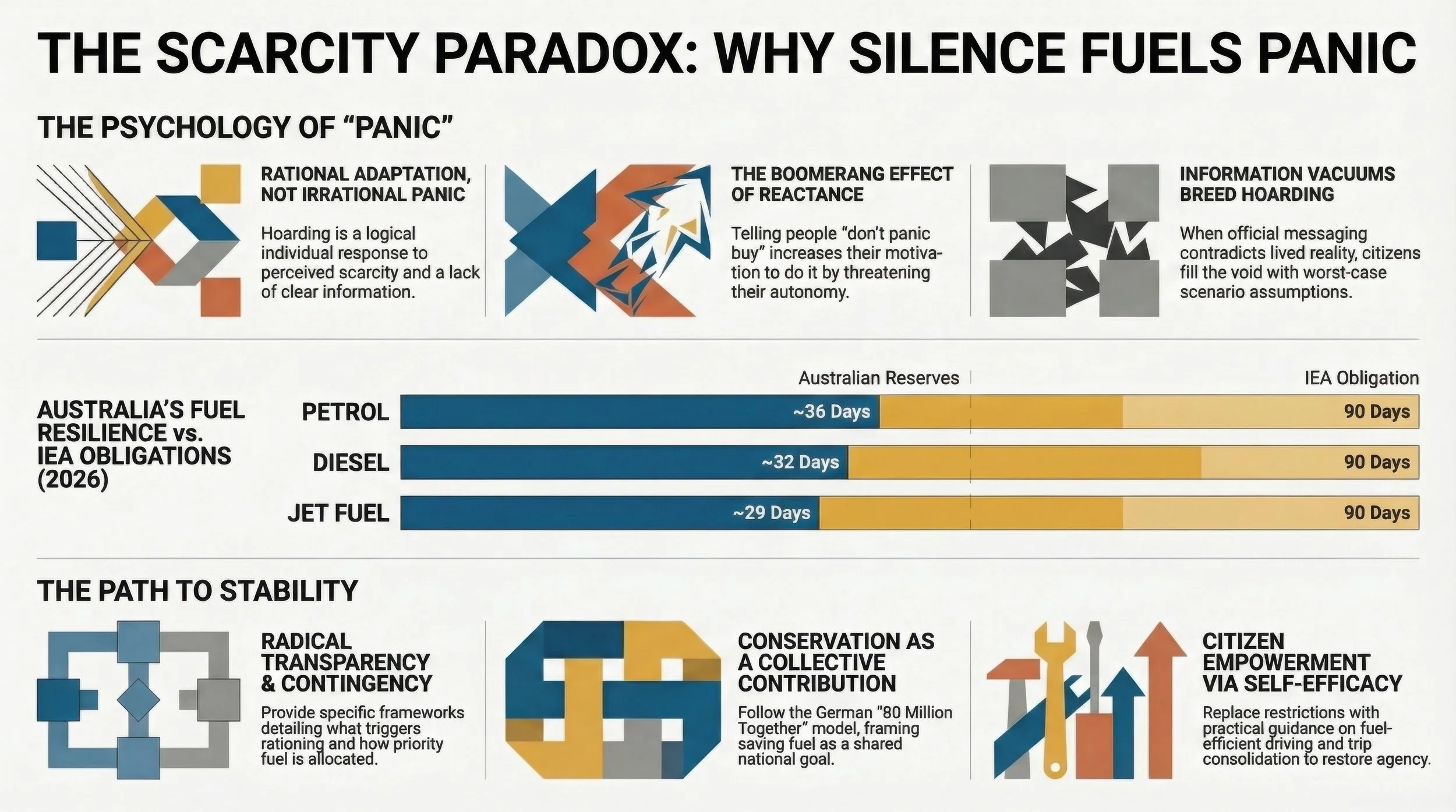
Australia holds roughly 36 days of petrol, 32 days of diesel, and 29 days of jet fuel — the largest domestic stockpile in 15 years, yet still the lowest of any IEA member nation. The IEA requires members to hold 90 days of net import cover. Australia has been non-compliant since 2012 and is the only IEA member that fails to meet this obligation. The average IEA member holds approximately 140 days. Energy Minister Chris Bowen has stated the government does not plan to meet the 90-day standard, estimating it would cost $20 billion over four years to build the necessary infrastructure.
What the government has said — and what it hasn’t
The Albanese government’s response has been a mixture of concrete action and carefully hedged reassurance. On 13 March, Bowen announced the release of up to 762 million litres of petrol and diesel from domestic reserves — 20% of the Minimum Stockholding Obligation — and temporarily relaxed sulphur fuel quality standards for 60 days, allowing Ampol’s Lytton refinery to redirect higher-sulphur product (50 parts per million instead of 10 ppm) to the domestic market, adding an estimated 100 million litres per month. On 19 March, Prime Minister Albanese convened a snap National Cabinet meeting and appointed former Australian Energy Regulator CEO Anthea Harris as coordinator of a fuel supply taskforce.
Albanese’s public messaging has walked a deliberate line: “I want to assure Australians at this time that Australia is well prepared. Our fuel supply is currently secure. However, I want us to be over prepared.” Deputy Prime Minister Richard Marles told Sky News that “the same amount of fuel that is coming into the country today as was coming in prior to this conflict starting” — while conceding he “could not guarantee supply if the conflict drags on.” Bowen has explicitly stated rationing is “not what we’re contemplating.” The government has refused to reduce the fuel excise (currently 51.6 cents per litre), despite prices reaching $2.19/litre nationally and exceeding $2.50/litre in regional areas.
What the government has conspicuously not done is provide citizens with a clear, specific contingency framework. Greg Bourne, former president of BP Australasia, warned SBS News that if the crisis continues, Australia enters rationing territory “within 30 days.” The National Farmers’ Federation reports farmers “running out, or running out of fuel, while others are only a week or two away from empty.” Yet the official line remains that rationing is not being contemplated — creating precisely the information vacuum that crisis communication research identifies as the breeding ground for panic and hoarding.
The ACCC has taken a more aggressive transparency posture, launching enforcement investigations into Ampol, BP Australia, Mobil Oil, and Viva Energy over potential anti-competitive conduct in diesel distribution and commencing weekly market updates. ACCC Chair Gina Cass-Gottlieb broke with normal practice to publicly announce the investigation “given the significance of the issue.” Victoria introduced a 24-hour fuel price lock requiring all 1,500+ retailers to publish maximum prices, with fines exceeding $3,000 per breach.
The panic buying paradox and what research actually shows
Despite government assurances, fuel sales have increased 35–40% in some areas with no corresponding increase in actual consumption. Queensland distributor Bartranz Petroleum reported receiving just 10% of its usual daily fuel allocations from Brisbane — not because imports had stopped, but because retail hoarding had drained the distribution system. Multiple regional towns across NSW, Victoria, Queensland, and Western Australia have run completely out of fuel. A New England service station imposed a $20 limit per customer — barely enough to reach the nearest town 60 kilometres away.
Bowen’s response — “Panic buying does not help the situation, panic buying very much causes the situation” — is factually correct but communicatively counterproductive. Research on psychological reactance theory, first proposed by Jack Brehm in 1966 and confirmed across decades of subsequent studies, demonstrates that telling people not to do something can increase their motivation to do it. Messages with high-controlling language arouse greater reactance than those using autonomy-supportive framing, and can produce “boomerang effects” where behaviour moves in the opposite direction to the communicator’s intent.
The UK’s 2021 fuel crisis provides the closest parallel. Despite having no actual fuel shortage — only a shortage of truck drivers to deliver it — media reports of a leaked government briefing triggered panic buying that emptied up to 90% of petrol stations in some areas within days. Jerry can sales jumped 1,656% in a single weekend. The government’s response — Transport Secretary Grant Shapps urging people to “carry on as normal” — failed because, as consumer psychologist Cathrine Jansson-Boyd observed, “people aren’t hearing a solution. What people need to calm down is well thought-through structures that will reassure them that we have sorted this problem out, and that’s just not coming through.”
The critical insight from crisis communication research is that what looks like panic is usually rational individual behaviour. Buying extra fuel when supply appears threatened is a logical response to perceived scarcity. The UK Government’s own Behavioural Science Team concluded in 2022 that “assuming the public will panic leads to flawed recommendations” and “a misplaced focus on mitigating panic over more meaningful objectives.” The evidence-based alternative is not reassurance without substance — it is actionable transparency: telling citizens specifically what the situation is, what the plan is, what they should do, and why their actions matter.
When democracies got crisis communication right — and wrong
The most instructive contrast comes from Germany’s 2022 energy crisis response. Facing the loss of 55% of its gas imports after Russia’s invasion of Ukraine, the Habeck government launched the “80 Million Together for Energy Change” campaign — framing energy conservation not as deprivation but as collective resistance. The messaging was blunt: “Every cubic metre of gas we use finances a war of aggression.” Crucially, it was paired with concrete regulatory action: mandatory temperature reductions in offices, heating bans for public swimming pools, Berlin’s Brandenburg Gate going dark after 10pm. The government offered practical empowerment — specific energy-saving tips, the €9 monthly transit ticket (52 million sold), measurable targets. German household gas consumption fell 15.2% and storage targets were met ahead of schedule.
The formula that works across historical crises is remarkably consistent. WW2 rationing succeeded through equity framing (“Rationing safeguards your share”), community-level administration (5,600 local boards staffed by 100,000 citizen volunteers in the US), practical empowerment (Victory Gardens, austerity recipes), and strong moral framing linking personal sacrifice to a shared purpose. Australia’s own WW2 rationing under Dr H.C. Coombs deployed the same toolkit — the “Austerity Campaign” of August 1942 made the message “Save Australia,” with coupon expiry dates designed explicitly to prevent hoarding.
The formula that fails is equally consistent. Scott Morrison’s Hawaii holiday during the 2019–20 Black Summer bushfires — taken secretly while over 100 fires burned — created a credibility gap no subsequent messaging could bridge. COVID-19 in the United States violated all six principles of the CDC’s own Crisis and Emergency Risk Communication framework, with political leaders contradicting scientists for months. A European Parliament study found “a clear pattern that those countries with comparatively poorer communication strategies experienced more deaths during the COVID-19 pandemic.”
Australia’s own COVID inquiry (October 2024) found that “public trust was further undermined by a lack of transparency in decision-making” and that disease models informing key decisions were “opaque and not open to scrutiny or peer review.” The inquiry recommended building “coordinated national public health emergency communication mechanisms to deliver timely, tailored and effective communications.” Whether those lessons have been absorbed is now being tested in real time.
The democratic obligation that underpins everything
The philosophical case for government transparency during crises is not peripheral — it is foundational to democratic legitimacy itself. John Locke’s framework, embedded in the architecture of liberal democracies, holds that government authority derives from the consent of the governed. Consent without information is meaningless. James Madison argued that “the very basis for government’s responsiveness to the people was the assurance that citizens have sufficient knowledge to direct it.” The French Declaration of the Rights of Man stated explicitly that “the society has the right of requesting an account from any public agent of its administration.”
Modern research validates this philosophical position with empirical evidence. Cass Sunstein and Adrian Vermeule’s influential 2008 paper on conspiracy theories introduced the concept of “crippled epistemology” — conspiracy theories flourish when people have access to very limited information and “what they know is wrong.” Isolated communities encountering only misleading information become breeding grounds for beliefs that have a “self-sealing quality,” where attempts to dispel them are reinterpreted as further proof. The solution, Sunstein and Vermeule argue, is not more reassurance but breaking informational isolation through trusted, substantive disclosure.
Australia’s transparency infrastructure is under strain at precisely the wrong moment. The Centre for Public Integrity has documented that FOI requests granted in full fell from 59% in 2011–12 to just 25% in 2023–24, while outright refusals ballooned from 12% to 23%. Average review processing times blew out from 6 months to 15.5 months. The Albanese government’s recent FOI Amendment Bill — proposing to ban anonymous requests and introduce new charges — was only abandoned in March 2026 after Senate opposition. As the Australia Institute’s Bill Browne observed: “An open and transparent government is the best antidote to democratic backsliding and the loss of trust in government and politicians.”
A 2025 study across six European countries in Public Management Review found “a strong relationship between procedural transparency and trust, with citizens ranking transparency as the key value in crisis management.” The WHO Bulletin has established that “transparency about what is not known is just as important to the promotion of public trust as transparency about what is known.” The evidence is unambiguous: concealing uncertainty does not prevent panic — it destroys the trust governments need when they need it most.
What evidence-based crisis communication actually looks like
Matthew Seeger’s foundational 2006 research synthesised ten best practices from expert panels: pre-event planning, partnerships with the public, listening to public concerns, honesty and openness, collaboration with credible sources, media accessibility, empathy, acceptance of uncertainty, and — critically — messages of self-efficacy that empower citizens to act. The key insight is that providing risk information without matching empowerment information may cause disengagement. People need to feel they can do something meaningful, not just absorb bad news.
Applied to Australia’s current fuel crisis, the evidence points toward a communication strategy the government has only partially adopted:
Acknowledge the genuine severity of the supply chain vulnerability rather than insisting supply is “currently secure” when regional towns are running dry. The gap between official reassurance and lived experience is the single most corrosive factor in crisis communication.
Provide a specific contingency framework — if the Hormuz closure persists for 30, 60, or 90 days, what happens? What triggers rationing? What are the priority allocations? Pre-announced frameworks reduce uncertainty and give citizens a mental model for what to expect.
Frame conservation as contribution, following Germany’s successful model — “every litre you save extends Australia’s resilience” rather than “don’t panic buy.”
Empower rather than restrict — provide practical guidance on fuel-efficient driving, trip consolidation, community carpooling, and agricultural diesel prioritisation, making citizens agents rather than passive consumers of reassurance.
Maintain radical transparency on reserve levels — the shift to weekly MSO reporting is a step in the right direction, but publishing real-time regional supply data would transform citizens from panicked information-seekers into informed participants.
Conclusion
Australia’s fuel crisis is not merely an energy security emergency — it is a stress test of democratic governance itself. The country’s structural vulnerability, built over two decades of refinery closures and chronic underinvestment in reserves, was predictable and predicted. ASPI’s Raelene Lockhorst warned in early 2025 that fuel insecurity was “not hypothetical” and “no longer a theoretical risk; it’s an active, accelerating threat.” Defence war games found that reduction of critical imports “would severely hamper industries and services across Australia.” The Navy’s Sea Power Centre published an annotated bibliography of fuel security warnings spanning decades — a document that reads, in March 2026, as a chronicle of institutional negligence.
The communication challenge now facing the Albanese government is whether to continue the pattern of calibrated reassurance — “supply is secure, don’t panic” — or to make a riskier but historically more effective choice: radical honesty paired with practical empowerment. Every successful crisis communication case study, from WW2 rationing to Germany’s 2022 energy campaign, confirms that citizens respond to shared sacrifice when they understand the stakes and trust that the burden is equitably distributed. Every failure — the UK’s 2021 fuel crisis, Morrison’s bushfire absence, COVID opacity — confirms that the gap between official messaging and observable reality is lethal to public trust.
The deepest lesson of this crisis may be that the information citizens lack is not about fuel levels but about their government’s willingness to level with them. As Dr Lurion De Mello of Macquarie Business School observed: “Australia will not run out of petrol tomorrow. But in a world where a single conflict can immobilise a fifth of global oil trade overnight, relying on luck is not a strategy.” The same could be said of relying on reassurance. Trust, once lost to an information vacuum, is harder to replenish than a strategic petroleum reserve.