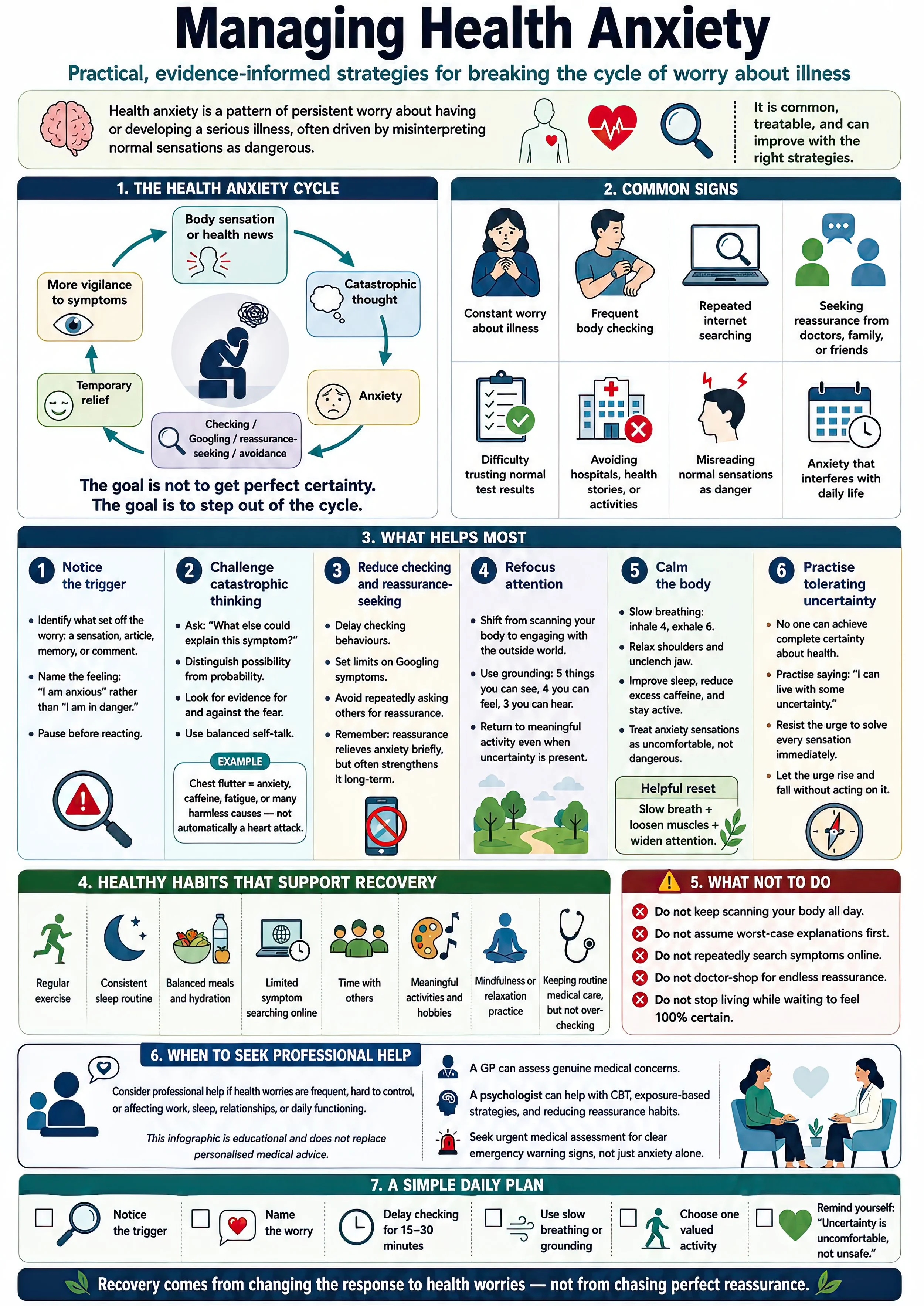
Health Anxiety
TL;DR
Health anxiety is a common, treatable, dimensional problem — running from normal, adaptive caution through to the clinical disorders the DSM-5-TR calls Illness Anxiety Disorder and Somatic Symptom Disorder, and the ICD-11 calls hypochondriasis (now grouped near OCD). It is maintained not by the body but by what we doabout our fears: checking, googling, and seeking reassurance.
Cognitive Behavioural Therapy (CBT) is the clear first-line treatment, with a large effect size (d = 1.01 versus controls in the Cooper et al. 2017 meta-analysis) and benefits sustained to 5–8 years in the CHAMP trial; medication (SSRIs) works but is best seen as second-line or adjunctive — a genuine “skills before pills” picture supported by the evidence.
In Australia, effective help is accessible now: a GP Mental Health Treatment Plan unlocks Medicare-subsidised psychology sessions, and free or low-cost internet CBT programs (THIS WAY UP’s dedicated Health Anxiety course, MindSpot Clinic) are proven and available immediately.
Key Findings
It is common and costly. The 2007 Australian National Survey of Mental Health and Wellbeing found a lifetime prevalence of health anxiety of 5.7% and a current prevalence of 3.4%, peaking in middle age; severe sufferers use 41–78% more healthcare per year than people with genuine medical conditions.
Reassurance is the trap. Medical reassurance, googling and body-checking all reduce anxiety briefly, then strengthen it — the central paradox of the disorder.
The “hypochondriac” label is obsolete and stigmatising. DSM-5 (2013) abandoned it; ICD-11 retained the term but radically reframed it as closer to OCD than to somatoform disorders.
Recovery is the realistic expectation, not the exception. Most people who engage with CBT improve substantially and stay improved for years.
Details
1. What health anxiety is, and how thinking about it has changed
Health anxiety is excessive worry about having, or developing, a serious illness — worry that is out of proportion to any actual medical danger and that persists despite appropriate reassurance and normal test results. Crucially, it is best understood dimensionally: it sits on a continuum that runs from normal, adaptive health concern (the prompt that makes us check a suspicious mole or attend a screening) through to a disabling clinical disorder. Paul Salkovskis and Hilary Warwick, who developed the dominant cognitive-behavioural model, argued that severe health anxiety is “not a qualitatively distinct problem but represents the extreme end of a continuum of health anxiety.”
Historical context. For most of the twentieth century the condition was called hypochondriasis — a term carrying centuries of pejorative baggage (the “worried well,” the “heartsink patient”). It was classified among the somatoform disorders, which framed the problem as being about physical symptoms. Two problems drove change: the term was stigmatising and disliked by patients and clinicians alike, and the somatoform framing misidentified the core feature. Health anxiety is fundamentally about fear and misinterpretation, not about the presence of bodily symptoms.
DSM-5 and DSM-5-TR (2013/2022). The American Psychiatric Association deleted “hypochondriasis” and split former cases into two diagnoses:
Illness Anxiety Disorder (IAD): (A) preoccupation with having or acquiring a serious illness; (B) somatic symptoms are absent or only mild in intensity; (C) there is a high level of health anxiety and the person is easily alarmed about their personal health; (D) they perform excessive health-related behaviours (e.g. repeatedly checking the body for signs of illness) or show maladaptive avoidance (avoiding doctor’s appointments and hospitals); (E) the preoccupation has lasted at least 6 months, though the specific feared illness may change over that time; and (F) it is not better explained by another mental disorder. DSM-5 specifies two subtypes: care-seeking and care-avoidant.
Somatic Symptom Disorder (SSD): one or more distressing somatic symptoms, accompanied by disproportionate and persistent thoughts, feelings or behaviours about them (disproportionate thoughts about seriousness, persistently high health anxiety, excessive time and energy devoted to symptoms), typically persisting more than 6 months. Here, distressing physical symptoms are prominent.
The estimated split is that roughly 75% of people who would previously have been diagnosed with hypochondriasis fall under SSD (because they have prominent physical symptoms), and about 25% under IAD — a retrospective study of 58 hypochondriasis patients found 76% met SSD criteria and 24% met IAD criteria. This split is contested. A 2022 study of treatment-seeking health-anxious patients (N = 334) concluded the IAD/SSD distinction had “questionable utility in pathological health anxiety” — most “validators” were similar, including response to CBT — leading the authors to ask whether we should “close the chapter” on the distinction. Reliability of the newer categories is, however, better than the old hypochondriasis label (kappa ≈ 0.80 for IAD and 0.92 for SSD, versus 0.60 for hypochondriasis).
ICD-11 (the WHO system, in use from 2022). The ICD took a different path. It retained the term hypochondriasisbut moved it out of the somatoform grouping and into the new Obsessive-Compulsive and Related Disorders (OCRD) chapter, alongside OCD, body dysmorphic disorder, olfactory reference disorder and hoarding — while also cross-listing it with the anxiety and fear-related disorders. The rationale: hypochondriasis shares phenomenology with OCD (intrusive preoccupations, repetitive checking, reassurance-seeking) and with the anxiety disorders (fear, hypervigilance, avoidance), and somatic symptoms are not an essential feature. This is a meaningful divergence from DSM: ICD-11 frames health anxiety as closer to OCD/anxiety, while DSM-5’s SSD remains in a somatic-symptom grouping.
The take-home for the public: the labels differ across systems, but the underlying clinical reality — disproportionate, persistent illness fear with checking, reassurance-seeking or avoidance — is what matters, and it responds to the same treatment regardless of which box it is filed in. This is why health anxiety is increasingly treated as a transdiagnostic, dimensional construct rather than a discrete category.
2. How common is it, and what does it cost?
General population: The Australian national survey by Sunderland, Newby & Andrews (2013, British Journal of Psychiatry), drawing on the 2007 National Survey of Mental Health and Wellbeing, found that “health anxiety affects approximately 5.7% of the Australian population across the lifespan and 3.4% currently met criteria for health anxiety at the time of the interview” (12-month prevalence 4.2%), with a peak in middle age. International general-population estimates for clinically significant health anxiety cluster around 6% (and up to 20% among those with other health concerns), while narrowly defined full hypochondriasis is rarer (generally under 1%).
Medical settings: Health anxiety is much more common among people attending medical clinics. A systematic review (Weck et al.) found a range of 0.3–8.5% in general medical settings, and the CHAMP research program found rates around 12% in clinics such as cardiology and endocrinology. In the CHAMP screening phase, nearly 20% of 5,769 medical outpatients screened scored at or above the clinical cut-off (≥20) on the Health Anxiety Inventory.
Rising over time / cyberchondria: A meta-analysis by Kosic, Lindholm, Järvholm, Hedman-Lagerlöf & Axelsson (2020, Journal of Anxiety Disorders; 68 studies, 22,413 students) found clinically significant health anxiety among college students “increased from 8.67% to 15.22%” between 1985 and 2017, with the pooled Illness Attitudes Scales score rising 4.61 points (95% CI 1.02–8.20) — a rise some attribute to internet symptom-searching.
Demographics and course: It affects women somewhat more than men, tends to be chronic if untreated, and is associated with high distress, disability and elevated mental-health service use.
Economic burden: Severe health anxiety is costly. Fink, Ørnbøl & Christensen (2010, PLoS ONE), a two-year primary-care follow-up, found that “the severe Health anxiety patients used about 41–78% more health care services... per year than patients with a well-defined medical condition,” both before and after the index consultation — and concluded the condition “is costly for the health care system and must be taken seriously.” A 2023 systematic review (Kawka et al., BMC Public Health) found the reported economic burden of hypochondriasis ranged from US$857 to US$21,138 per patient per year (2022 dollars), while cautioning that studies are not directly comparable and that indirect costs (lost productivity) are systematically under-measured — in one Swedish study indirect costs were more than twice the direct costs.
3. What causes and maintains it
The cognitive-behavioural model (Warwick & Salkovskis, 1990; Salkovskis, Warwick & Deale, 2003). This is the engine of modern understanding and treatment. The model proposes that early experiences (childhood illness, a relative’s illness or death, exposure to illness information) lay down dysfunctional assumptions about health, organised around four belief types: the perceived (i) likelihood of illness, (ii) awfulness of illness, (iii) one’s inability to cope with it, and (iv) the inadequacy of medical help to treat it. A “critical incident” (a new bodily sensation, a news story, a death) activates these beliefs, triggering catastrophic misinterpretation of benign bodily sensations as signs of serious disease.
This misinterpretation drives four self-defeating processes that maintain the anxiety:
Increased physiological arousal — anxiety itself produces real bodily sensations (palpitations, dizziness, muscle tension, gut changes) which are then misinterpreted as further evidence of disease, closing a vicious cycle.
Attentional bias / body hypervigilance — scanning the body for signs makes ordinary sensations more salient and “findable.”
Safety-seeking behaviours — checking, reassurance-seeking, googling, avoidance.
Mood changes — anxiety and low mood that amplify symptom perception.
Intolerance of uncertainty is a key transdiagnostic driver: the inability to tolerate the small but non-zero possibility of being ill. Inflated responsibility (feeling personally responsible for detecting and preventing disease) also features, echoing OCD.
Developmental and aetiological factors (relevant to a schema/trauma-informed practice): childhood experiences of illness (one’s own or a parent’s), parental modelling of illness behaviour, early bereavement, and adverse childhood experiences are linked to later health anxiety. Insecure attachment is implicated — the cognitive-behavioural and interpersonal models both note that beliefs develop in response to “aversive learning experiences during childhood... such as the death or illness of an attachment figure.” Temperamentally, neuroticism/negative affectivity and anxiety sensitivity are vulnerability traits (neuroticism is roughly 30% heritable).
Cyberchondria. Online symptom-searching has a reciprocal, anxiety-amplifying relationship with health anxiety. Doherty-Torstrick et al. (2016) found that severity of illness anxiety on the Whiteley Index was the strongest predictor of increased anxiety during and after searching — health-anxious people recalled feeling worse after symptom-checking, whereas low-anxiety people recalled relief. Searching functions as a form of reassurance-seeking that escalates (“query escalation” — moving from “headache” toward “brain tumour”), and the effects are short-lived, fuelling further searching. Researchers have proposed that, regardless of which comes first, online health searches reliably leave health-anxious people more anxious than before.
The reassurance trap. This is the single most important practical insight. Medical reassurance, test results, googling and asking loved ones all work — briefly. Anxiety drops, which powerfully reinforces the behaviour. But the underlying fear is untouched, the relief decays, and the person returns for more. Over time, reassurance-seeking behaves exactly like a compulsion: as one review puts it, “Excessive reassurance-seeking is addictive. It quickly diminishes anxiety, leading to immediate relief. However, the relief does not last and reassurance-seeking returns.” Well-meaning reassurance from doctors can therefore maintain the problem, and over the longer term standard medical reassurance can leave the most anxious patients no better or worse.
4. Symptoms and presentation
Cognitive: preoccupation with illness; catastrophic interpretation of sensations; “what if” thinking; disease conviction; rumination; vivid catastrophic imagery (often of body parts “giving out”).
Emotional: anxiety, dread, frustration, depression, shame.
Behavioural: repeated body-checking (palpating, examining, weighing, taking pulse/blood pressure); reassurance-seeking from doctors, family and the internet; “doctor shopping”; repeated tests; avoidance of medical settings, illness reminders, news, or exertion (the care-avoidant pattern).
Physical: the real somatic symptoms of autonomic arousal — palpitations, breathlessness, dizziness, gastrointestinal upset, tension — which are themselves misread as disease.
In the GP’s office, presentation varies. The care-seeking patient consults frequently, requests tests and struggles to be reassured; the care-avoidant patient may stay away from doctors entirely out of fear of bad news. In clinical samples many patients fluctuate between the two — one study found 61% of IAD patients fluctuated between seeking and avoiding care, versus 25% purely care-seeking and 14% purely care-avoidant.
Comorbidity is the rule, not the exception. Health anxiety frequently coexists with major depression, generalised anxiety disorder, panic disorder and OCD.
5. Telling it apart from other conditions
Panic disorder: also involves catastrophic misinterpretation of bodily sensations, but the focus is on immediatecatastrophe (e.g. “I’m having a heart attack now”) during acute panic, with between-episode worry centred on having more panic attacks — versus health anxiety’s enduring fear of an underlying, undiagnosed disease.
GAD: worry spans many domains; in health anxiety, worry is concentrated on health.
OCD: shares intrusive preoccupations and checking/reassurance compulsions; OCD illness fears are often about contamination/contracting illness, and sufferers typically recognise their fears as irrational, whereas health-anxious disease conviction can feel more plausible to the person.
Somatic Symptom Disorder: distress centres on the symptoms themselves; in IAD, distress centres on what the (minimal or absent) symptoms might mean.
Body dysmorphic disorder: preoccupation with perceived appearance defects, not illness.
Genuine medical illness: the essential and humane point is that health anxiety can coexist with real disease.Having a diagnosed condition does not exempt someone from disproportionate illness fear, and the two require parallel management. CHAMP deliberately included patients with concurrent medical illness and still found CBT effective.
6. Assessment and diagnosis
Clinicians assess health anxiety through clinical interview plus validated self-report measures:
Short Health Anxiety Inventory (SHAI; Salkovskis, Rimes, Warwick & Clark, 2002) — an 18-item (and 14-item) measure with two factors (illness likelihood; negative consequences of illness). A systematic review (Alberts et al., 2013) found good-to-excellent internal consistency (α = .74–.96) and that it is sensitive to treatment. Suggested screening cut-offs vary by setting; a Swedish validation of the SHAI-14 found an optimal cut-off of 18 versus healthy controls (22 in a psychiatric clinic, 29 in low-prevalence settings), with scores of 33–42 indicating substantial health anxiety.
Whiteley Index (Pilowsky, 1967) — a classic 14-item hypochondriasis measure (yes/no format).
Illness Attitude Scales and the Health Anxiety Inventory (HAI) — the HAI (≥20 cut-off) was the primary outcome instrument in the CHAMP trial.
A central clinical principle, consonant with “skills not pills”: appropriate, proportionate medical workup to exclude genuine disease — and then a deliberate stop to endless investigation, because repeated testing functions as reassurance-seeking and feeds the disorder.
7. Treatment — what the evidence actually shows
CBT is first-line and best-evidenced. The key meta-analysis is Cooper, Gregory, Walker, Lambe & Salkovskis (2017, Behavioural and Cognitive Psychotherapy), which pooled 21 comparisons and found “a large effect size for CBT compared with a control condition... at post therapy d = 1.01 (95% confidence interval 0.77–1.25),” maintained at 6- and 12-month follow-up. CBT outperformed treatment-as-usual, waitlist, medication and other psychological therapies. A 2007 Cochrane review reached similar conclusions.
The landmark real-world trial is CHAMP (Tyrer, Salkovskis et al.; Lancet 2014; 5-year outcomes 2017; 8-year 2021): 444 medical outpatients aged 16–75 scoring ≥20 on the HAI in cardiology, endocrinology, gastroenterology, neurology and respiratory clinics across five UK general hospitals, randomised to 4–10 sessions of adapted CBT (CBT-HA; 219 patients, mean ~6 sessions) versus standard care (225). “Improvement in HAI scores at 3 months was significantly greater in the CBT-HA group... maintained over the 5-year period (overall p < 0.0001), with no loss of efficacy” — the primary outcome favoured CBT by 2.97 HAI points at one year, and the advantage persisted out to 8 years (HAI difference 1.83, p = 0.023). Notably, depression worsened in standard care: at 8 years depression was significantly higher in the standard-care arm (p < 0.003), prompting the authors’ striking conclusion that “standard care for health anxiety in medical clinics promotes depression.” CBT was effective even when delivered by trained nurses, whose outcomes were “superior to those of other therapists,” and total healthcare costs were similar between arms over five years (£12,591 for CBT-HA vs £13,335 for standard care) — i.e. effective treatment essentially paid for itself.
Key CBT components for health anxiety:
Psychoeducation and collaborative formulation (building the personal “vicious flower” / maintenance cycle).
Cognitive restructuring of catastrophic misinterpretations and health beliefs.
Behavioural experiments (e.g. testing whether body-focus creates sensations).
Exposure and response prevention (ERP): exposure to feared illness cues and situations while dropping safety behaviours — crucially, stopping reassurance-seeking, checking and googling.
Attention training (shifting away from internal body-scanning).
Reducing reassurance-seeking and checking — the behavioural heart of treatment.
Relapse prevention.
Third-wave approaches. Acceptance and Commitment Therapy (ACT) has direct RCT support: Eilenberg, Fink, Jensen, Rief & Frostholm (2016, Psychological Medicine) found group-based ACT (ACT-G; 126 patients) effective for severe health anxiety, with psychological flexibility as the mechanism of change. Mindfulness-based cognitive therapy has also shown significant effects on severe health anxiety. These are reasonable alternatives or supplements to traditional CBT, especially where uncertainty-acceptance is the sticking point.
Internet-delivered CBT (iCBT) — highly relevant to Australia. iCBT for health anxiety has strong RCT support (originating in Sweden with Hedman et al., 2011, British Journal of Psychiatry), and Australian researchers (Jill Newby and colleagues at UNSW/CRUfAD) developed and validated the first English-language clinician-guided iCBT program for health anxiety, showing it reduces both health anxiety and cyberchondria, and is effective in routine community care. Across conditions, iCBT achieves outcomes broadly comparable to face-to-face CBT, though effect sizes tend to be somewhat smaller.
Medication (SSRIs). SSRIs work, but fit a clear second-line/adjunctive role. RCTs support fluoxetine (Fallon et al., 2008) and paroxetine (Greeven et al., 2007, American Journal of Psychiatry), with paroxetine roughly as effective as CBT in head-to-head comparison. A systematic review of six RCTs supports SSRIs (fluoxetine, paroxetine, sertraline, escitalopram, fluvoxamine) for hypochondriasis. Combined CBT + SSRI was tested in Fallon et al. (2017, American Journal of Psychiatry; N = 195, four arms): response rates were 47.2% for joint treatment (fluoxetine + CBT), 41.8% for single active treatment, and 29.6% for placebo (trend p = 0.036). The authors concluded the combination provided only “a small incremental benefit,” and that “approximately 50% of patients did not respond to the study treatments” — underlining that medication is not a magic bullet and psychological skills remain central. Fluoxetine showed a clearer signal than CBT on some secondary continuous measures, but the combination did not significantly outperform monotherapy. Benzodiazepines should be avoided (potentially counterproductive).
The “skills not pills” verdict: the evidence genuinely supports leading with psychological treatment. CBT has the largest and most durable effect, treats the maintaining mechanisms directly, avoids medication side-effects and dependence, and is cost-neutral to the health system. SSRIs are a legitimate option — particularly with comorbid depression, severe presentations, or where CBT is declined or unavailable — but for most people they are not the necessary first step.
8. Self-help and practical strategies
Evidence-based self-help mirrors the CBT components:
Cut the checking and googling. Treat symptom-searching as a compulsion: it provides fleeting relief and worsens anxiety. Delete bookmarked symptom-checkers; use website blockers if needed.
Postpone and reduce reassurance-seeking. Agree, ideally with family and GP, to a “reassurance diet” — because reassurance maintains the fear rather than resolving it.
Practise sitting with uncertainty. Health certainty is unattainable; the skill is tolerating the unknown rather than trying to resolve it.
Worry postponement and scheduled “worry time.”
Attention strategies — deliberately disengaging from body-scanning.
Behavioural experiments — e.g. noticing how focusing on a body part generates sensations.
Lifestyle — sleep, exercise, and reducing caffeine (which mimics anxiety symptoms).
Supporting a loved one. The hardest message for families: constant reassurance backfires. Repeatedly answering “Do you think it’s cancer?” or accompanying endless checking feels kind but feeds the disorder. Better is compassionate, consistent non-participation in the reassurance cycle (ideally planned with the person and their clinician), validating distress while not feeding the behaviour, and encouraging professional help.
When to seek help: when health worry is persistent (months), distressing, time-consuming, driving repeated consultations/tests or avoidance, or impairing work, relationships or quality of life.
9. Accessing help in Australia
Start with a GP. The GP can exclude genuine illness with proportionate workup and prepare a Mental Health Treatment Plan (MHTP) under the Better Access initiative. Per the Department of Health, “eligible patients can claim a Medicare benefit for up to 10 individual and 10 group therapy mental health treatment services per calendar year (1 January to 31 December).” Referrals are typically issued in an initial block of up to 6 sessions, after which you return to your GP for review before further sessions. (Note a 2025 administrative change: from 1 November 2025, MHTP referrals must generally come from the patient’s MyMedicare-registered GP or usual medical practitioner.)
See a clinical psychologist for CBT/ACT — the treatments with the best evidence for health anxiety. Schema therapy and trauma-informed approaches may add value where developmental/attachment factors are prominent.
Australian digital programs (free or low-cost, evidence-based):
THIS WAY UP (a not-for-profit initiative of St Vincent’s Hospital, Sydney and UNSW) — a dedicated, CBT-based Health Anxiety online program (six modules, ~20 minutes three times weekly), plus broader anxiety programs; free when prescribed by a registered clinician, or a small fee (around $59) for self-enrolment.
MindSpot Clinic — free national telephone/online assessment and treatment courses for anxiety and depression.
Beyond Blue and Black Dog Institute — information, support and resources.
Crisis support: Lifeline 13 11 44.
10. Prognosis, recovery and myths
Outlook is genuinely good. Health anxiety is among the more treatable anxiety-spectrum problems. CBT produces large improvements that endure for years, and many people no longer meet diagnostic criteria after treatment. Untreated, it tends to be chronic and to drive depression and healthcare overuse — which is exactly why active treatment, rather than repeated reassurance, matters.
Common myths to dispel:
“Hypochondriacs are faking or attention-seeking.” False — the distress and symptoms are real; the fear is genuine.
“It’s just being a worrier — you can’t treat it.” False — it has a clear model and a strongly evidence-based treatment.
“If I get enough tests, I’ll finally feel reassured.” False — reassurance is the trap; more testing feeds the cycle.
“Health anxiety means there’s nothing physically wrong.” False — it can coexist with real illness; the issue is the disproportionate response.
“Medication is the answer.” Overstated — psychological skills are first-line; medication is a useful adjunct for some.
Recommendations
If you recognise yourself here: book a longer GP appointment, ask about a Mental Health Treatment Plan, and request referral to a clinical psychologist for CBT. In the meantime, start an evidence-based iCBT program (THIS WAY UP’s Health Anxiety course or MindSpot) — these work and you can begin today.
Begin reducing the maintaining behaviours now: stop googling symptoms, ration reassurance-seeking, and resist checking — expect anxiety to rise briefly, then fall. This single change is often the turning point.
Agree appropriate medical limits with one trusted GP: one clinician, proportionate workup, then a deliberate end to repeat testing — to break the investigation–reassurance loop.
For families: stop providing reassurance on demand; instead validate feelings, decline to participate in checking, and support treatment.
Medication threshold: consider an SSRI (with your doctor) if there is significant comorbid depression, the anxiety is severe, or CBT is unavailable or declined — but treat it as an adjunct to skills, not a substitute. Avoid benzodiazepines.
Benchmarks to reassess: if there is no meaningful improvement after a full course of CBT (roughly 6–12 sessions) or a completed iCBT program, revisit the formulation, consider adding ACT/mindfulness or an SSRI, and screen for untreated comorbidity (depression, OCD, trauma).
Caveats
Where evidence is mixed: the DSM-5 IAD/SSD split is genuinely contested — some research questions its clinical utility. Prevalence figures vary widely with definition and setting (sub-1% for narrow hypochondriasis up to ~6%+ for broad health anxiety). Economic-cost figures are inconsistently measured across countries and likely underestimate indirect (productivity) costs.
Effect sizes vary by comparison: the large d ≈ 1.0 for CBT is versus waitlist/usual care; against active comparators effects are more modest, and iCBT effects tend to be somewhat smaller than face-to-face. The single-arm CHAMP between-group HAI differences, while durable and statistically robust, were modest in absolute points — reflecting that CBT helps substantially but does not “cure” everyone.
This article is general information, not a substitute for individual assessment. Health anxiety can coexist with real disease, so new, persistent or red-flag symptoms always warrant proper (proportionate) medical assessment.