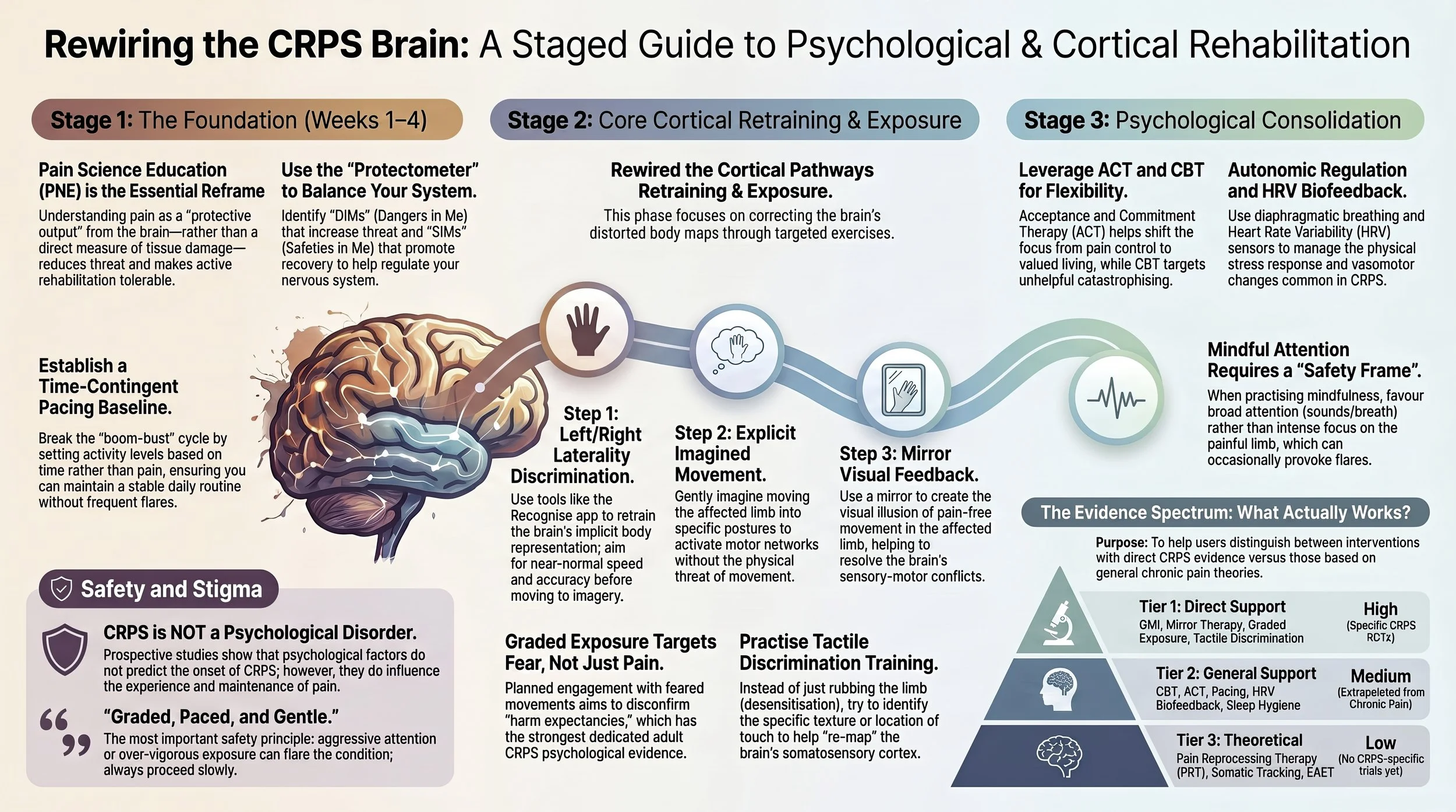
Retraining the Alarm: Psychological Techniques for Managing CRPS
Complex Regional Pain Syndrome (CRPS) is one of the most painful conditions known to medicine. If you or someone you love is living with it, you already know that. This article is not here to tell you the pain is imaginary, or that you can simply think your way out of it. You cannot, and anyone who says otherwise does not understand the condition.
What this article will do is explain something genuinely hopeful: the brain and nervous system play a huge role in CRPS, and there are practical, evidence-based skills you can learn to calm an overactive pain system, rebuild your relationship with the affected body part, and get more of your life back. Some of these techniques have been tested in CRPS specifically. Others come from the broader science of chronic pain and are a sensible fit. We will be honest throughout about how strong the evidence is for each one.
Think of this as a map. You do not have to try everything, and you certainly should not try everything at once. Read it, pick a starting point, and ideally work alongside a health professional who knows CRPS.
First, what is actually going on?
CRPS usually starts after an injury, sometimes a small one like a sprain or a fracture, or after surgery. The strange thing about CRPS is that the pain becomes far worse than the original injury should ever cause, and it lasts long after the tissues have healed. The affected limb might change colour or temperature, swell, sweat, grow extra hair or nails, or feel like it belongs to someone else. Even a light touch, a breeze, or the weight of a bedsheet can feel like fire or crushing pressure.
Here is the key idea, and it is worth reading twice. Pain is not a direct measurement of damage in your body. Pain is a protective alarm produced by your brain.
Most of us grow up believing that pain works like a pain meter: more damage means more pain, no damage means no pain. But that is not how it works. Pain is the brain's best guess about how much danger your body is in, and how much protection you need. Your brain builds that guess from many sources: signals from the tissues, yes, but also your emotions, your beliefs, your past experiences, your stress levels, and what the situation means to you. When the brain concludes you are in danger, it produces pain to make you protect the area. That is a good system when it works properly. It is what makes you pull your hand off a hot stove.
In CRPS, this alarm system has become faulty. After the original injury, the nerves and the spinal cord and the brain became more and more sensitive, a process called central sensitisation. The volume knob on the alarm got turned up and then jammed. Now the system fires off pain warnings in response to signals that should be harmless, like gentle touch or normal movement. The pain is completely real. The pain is severe. But it is no longer a reliable sign that harm is being done to the tissues. It is an overprotective alarm.
This matters enormously, because an alarm system that has learned to be too sensitive can, with the right approach, gradually learn to settle down again. That learning is what most of the techniques below are trying to achieve.
The brain's body map gets smudged
There is a second piece of the puzzle. Your brain contains a kind of map of your body, a detailed representation of every part, laid out across the surface of the brain. When a body part is in constant pain and you stop moving it, touching it, and looking at it, that map starts to blur and shrink. Scientists sometimes describe this as the map becoming "smudged".
You can often notice the effects of this smudging. Many people with CRPS find the affected limb feels foreign, bigger or smaller than it really is, or like it is not quite part of them. Some struggle to sense exactly where it is in space without looking. This distorted body sense is not you going mad. It is a measurable change in how the brain is representing that body part, and it is closely tied to the pain. The encouraging news is that the brain map can be sharpened again through specific exercises, and as the map improves, pain often eases too.
The foundation: understanding your pain
Before any of the hands-on techniques, there is one intervention that underpins them all, and it is simply learning how pain works. Researchers call this Pain Neuroscience Education, or sometimes "Explain Pain", a term made popular by Australian pain scientists Lorimer Moseley and David Butler.
This might sound too simple to be a real treatment. It is not. When people genuinely understand that their pain is an overprotective alarm rather than a sign of ongoing damage, several things happen. The pain becomes less frightening. Less fear means the brain perceives less threat, and less threat usually means less pain. People also become more willing to move and to gradually do more, because they are no longer terrified that movement is causing harm. Studies across chronic pain conditions show that this kind of education, on its own, can reduce pain and disability, and it makes every other treatment work better.
So the first "technique" is education itself. Read about how pain works. Watch reputable explanations. Let the new understanding sink in. A wonderful free starting point is the short animation and website called Tame the Beast, created by Lorimer Moseley, which explains all of this in about five minutes. The book Explain Pain goes much deeper if you want it.
A gentle warning here: the internet is full of frightening and inaccurate information about CRPS. Some of it will scare you and make your alarm system louder. Try to stick to reputable, science-based sources, some of which are listed at the end of this article.
Retraining the brain map: Graded Motor Imagery
This is where we get to the technique with some of the strongest CRPS-specific evidence, so it deserves close attention. Graded Motor Imagery (GMI) is a step-by-step brain training program developed largely through research by Moseley and colleagues. It was designed specifically for conditions like CRPS and phantom limb pain.
The clever idea behind GMI is this. Moving the painful limb often hurts too much to do straight away, and pushing through can flare the pain badly. But the brain areas involved in movement can be switched on and exercised gently, in stages, before you ask the limb to actually move. It is a bit like sneaking up on the problem so the alarm does not go off. GMI has three stages, and they are done in order, each one preparing the brain for the next.
Stage one: left or right?
The first stage is called laterality training, or left/right discrimination. You look at pictures of hands or feet (whichever matches your affected limb) in all sorts of positions and angles, and you decide as quickly as you can whether each one is a left or a right.
This sounds trivial, but here is what is happening. To judge whether a pictured hand is a left or a right, your brain quietly imagines rotating your own hand to match. It is accessing the smudged body map without you having to move anything. People with CRPS are often slower and less accurate at this task for their affected side, which is a sign of the smudging. With practice, speed and accuracy improve, and the map begins to sharpen.
You can do this at home using printed cards, or far more easily using the Recognise app made by the NOI Group, which is designed exactly for this. Practise little and often, several short sessions a day rather than one long one. You are not trying to exhaust yourself. You are gently waking up the brain map.
Stage two: imagined movements
Once left/right recognition has improved, you move to explicit motor imagery, which means imagining moving the affected limb without actually moving it. You picture your hand or foot making particular movements, as vividly as you can, feeling the movement in your mind's eye.
Imagining a movement activates many of the same brain areas as actually doing it, but usually without triggering the pain, provided you build up gently. This continues to exercise and refine the movement-related parts of the brain map. If imagining a movement starts to bring on pain, you make the imagined movements smaller, slower, or less frequent, and build up more gradually.
Stage three: mirror therapy
The final stage is mirror therapy, which is powerful enough that it also stands on its own, so it has its own section below.
How well does GMI work, honestly?
GMI has been tested in randomised controlled trials in people with CRPS, and reviews of the evidence suggest it can reduce pain and disability for some people. It does not work for everyone, and the effects vary. It also needs to be done properly and in the right order, because doing the stages out of sequence, or rushing, tends not to help and can flare symptoms. This is one area where guidance from a clinician trained in GMI, even just to get you started, is genuinely valuable. The full protocol is laid out in The Graded Motor Imagery Handbook.
Mirror therapy
Mirror therapy is strange, simple, and surprisingly well supported. You place a mirror upright beside the affected limb, positioned so that the mirror reflects your good limb and hides the affected one. When you look into the mirror, you see what appears to be a healthy, normally moving version of the painful limb, because you are actually seeing the reflection of the good side.
You then move the good limb, or move both together, while watching the reflection. Your brain receives the powerful visual message that the affected limb is moving smoothly and without harm. For reasons researchers are still working out, this visual feedback can reduce pain and improve movement, probably by helping to correct the mismatch between what the brain expects and what it senses, and by sharpening that body map again.
Early research on mirror therapy in CRPS, including work led by Candida McCabe, showed encouraging results particularly in more recent-onset cases, and it has become a standard part of CRPS rehabilitation. To try it, you only need a decent-sized mirror. Start with short sessions of a few minutes. If simply watching the reflection provokes pain or a strong emotional reaction, which does happen for some people, ease back to just looking at the still limb in the mirror before adding movement. Slow and gentle wins here.
Waking up the skin: sensory retraining and desensitisation
Because CRPS smudges the body map, the affected area often loses fine sensory sharpness, even while it has become painfully oversensitive to touch. Two related techniques address this, and they can be done at home.
Tactile discrimination training involves having different textures, shapes, or gentle touches applied to the affected area while you try to identify exactly what and where they are, often with your eyes closed and then checking. Training the skin to make fine distinctions again helps re-sharpen the sensory body map, and studies suggest this can reduce pain. A partner can help, or you can set up ways to do it yourself.
Desensitisation tackles the opposite problem, the extreme sensitivity to touch known as allodynia, where light contact feels painful. The approach is graded exposure for the skin. You begin with a texture or contact that is only mildly uncomfortable, perhaps a soft cloth, and expose the area to it gently and repeatedly until the nervous system starts to accept it as non-threatening. Over days and weeks, you very gradually work up to firmer or rougher textures. The principle is the same as with the alarm system generally: you are teaching the nervous system, through safe repeated experience, that this input is not dangerous. Patience is essential. Pushing too hard too fast tends to backfire.
Facing feared movements, gently: graded exposure and pacing
When any movement might trigger severe pain, it is completely natural to start avoiding movements and activities. Understandably, you protect the limb. The problem is that avoidance, over time, tends to make things worse. The limb gets weaker and stiffer, the body map smudges further, and the fear itself grows. Pain scientists call this trap the fear-avoidance cycle.
Two approaches help you break out of it.
Graded exposure to feared movements
Researchers including Johan Vlaeyen and Jeroen de Jong, and more recently Marlies den Hollander, have studied a treatment for CRPS based on gradually and deliberately facing the specific movements and activities a person fears most. This is not about gritting your teeth and pushing through agony. It is a structured process. You identify which movements frighten you and rank them from least to most scary. Then you start with a manageable one and repeat it in a planned, controlled way, discovering through experience that the feared catastrophe does not happen. As confidence grows, you work up the ladder.
A study by den Hollander and colleagues in 2016 found that this kind of exposure-based approach produced meaningful improvements for people with CRPS, which makes it one of the better-evidenced psychological strategies for the condition. Because it deals directly with fear and with movements that provoke pain, most people do this with a clinician guiding the pace, at least to begin with. But understanding the principle helps you approach movement more wisely on your own.
Pacing and the boom-bust trap
Many people with chronic pain fall into a pattern called boom and bust. On a good day, you feel a bit better, so you rush to catch up on everything you have been unable to do. You overdo it, and then you crash into a severe flare that puts you out of action for days. Then, once you recover a little, you overdo it again. Boom, bust, boom, bust.
Pacing breaks this cycle. The idea is to work out roughly how much of an activity you can do without triggering a flare, then deliberately do a bit less than that, and stop before the pain forces you to. You spread activity out and build it up slowly and steadily over time, rather than in desperate bursts. A useful method is to base activity on a set amount or time (a quota) rather than on how you feel in the moment, because how you feel is an unreliable guide that leads straight back to boom and bust. Pacing feels frustrating at first, because it means stopping while you still feel able to continue. Over weeks, though, it usually means fewer crashes and a slow, genuine increase in what you can do.
Working with thoughts: cognitive behavioural strategies
Cognitive Behavioural Therapy (CBT) is one of the most studied psychological approaches for chronic pain in general. Its evidence base is strongest across chronic pain broadly rather than in CRPS specifically, but the strategies are sensible and widely used. A couple of them translate well into self-help.
One is noticing and gently challenging catastrophising. Catastrophising is the mind's tendency to leap to the worst possible interpretation, with thoughts like "this will never get better", "something must be seriously damaged", or "I cannot cope with this". These thoughts are understandable, but they are also fuel for the alarm system, because a brain that believes it is in terrible danger produces more pain. The skill is to catch these thoughts, ask whether they are actually true and helpful, and deliberately practise more balanced and accurate ones, such as "this is a flare, flares pass" or "my alarm is loud right now, but it does not mean my limb is being harmed". This is not forced positive thinking or pretending everything is fine. It is replacing frightening exaggerations with something more accurate.
The other is behavioural activation, which is a formal way of saying: gently rebuild the meaningful and enjoyable activities that pain has stripped out of your life, in small graded steps, rather than waiting for the pain to go before you start living. Doing more of what matters, carefully paced, tends to lift mood and, through that, turns the alarm down a little too.
Making room for pain: acceptance and mindfulness
There is a genuine puzzle at the heart of long-term pain. Fighting the pain, tensing against it, and demanding that it disappear before you can get on with life often makes suffering worse, not better. A different family of approaches works with this reality rather than against it.
Acceptance and Commitment Therapy (ACT) is the best known. The word "acceptance" is easily misunderstood. It does not mean giving up, approving of the pain, or resigning yourself to a small life. It means stopping the exhausting, unwinnable war against sensations you cannot immediately control, so that your energy goes instead into the things you actually care about. ACT encourages you to get clear on your values, the kind of person and life that matter to you, and then to take small committed actions towards them even while pain is present. It also teaches a skill called defusion, which means learning to see thoughts as just thoughts, mental events passing through, rather than commands you must obey or truths you must believe. The evidence for ACT in chronic pain has been growing steadily, and it fits CRPS well because so much of the distress comes from the struggle against the pain.
Mindfulness is a related practice, often taught through a program called Mindfulness-Based Stress Reduction. At its simplest, mindfulness means paying attention to the present moment, on purpose, with a curious and non-judging attitude. Practised regularly, it can reduce the stress and reactivity that feed pain, and change your relationship to painful sensations so they feel less overwhelming.
A specific caution for CRPS, though. A common mindfulness exercise is the "body scan", where you slowly move your attention through each part of the body. For most people this is calming. But if you have a severely hypersensitive limb, deliberately focusing attention on it can sometimes increase the pain, at least early on. If that happens, it is fine to modify the practice: focus on the breath, or on non-painful parts of the body, or keep your attention on the painful area very light and brief, building up only as it feels safe. Mindfulness should reduce your suffering, not become another thing that flares you.
A newer idea: teaching the brain that safe pain is safe
In recent years, a set of approaches has emerged built directly on the idea that chronic pain can be an overprotective alarm that has, in effect, been learned, and can therefore be unlearned. The best known is Pain Reprocessing Therapy(PRT), associated with Alan Gordon. It combines strong pain education with a technique called somatic tracking, where you observe your pain sensations with calm curiosity and a sense of safety, gradually teaching the brain that the sensations, while real, are not dangerous.
Honesty matters here. The most striking evidence for PRT so far, including a well-known 2021 study run in Boulder, Colorado, was in people with chronic back pain, not CRPS. The underlying ideas about central sensitisation and threat certainly overlap with CRPS, and the general principle of reducing the threat value of pain runs through nearly everything in this article. But we do not yet have strong trials of PRT in CRPS specifically. Treat it as promising and mechanistically reasonable rather than proven for this condition, and be cautious of anyone marketing it as a guaranteed cure.
A related approach worth mentioning is Emotional Awareness and Expression Therapy, which is based on the idea that unprocessed stress and emotion can keep a sensitised pain system switched on, and that becoming more aware of and expressing those emotions can help. Again, the evidence is stronger in some other pain conditions than in CRPS, but it points to the same theme: emotions and the nervous system are deeply linked to pain.
Calming the nervous system directly
CRPS does not only involve pain. It involves disturbances in the automatic nervous system, the part that controls things like blood flow, temperature, and sweating. This is why the limb can change colour and temperature. That same automatic system is closely tied to stress. When you are stressed, it revs up, and a revved-up nervous system tends to amplify pain. So learning to settle that system is a reasonable and practical target.
Several simple skills help here. Slow diaphragmatic breathing, breathing gently and low into the belly with a longer breath out than in, is one of the most direct ways to shift the nervous system towards calm. Progressive muscle relaxation, where you gently tense and release muscle groups in turn (working around the painful area rather than into it), and autogenic training, where you use repeated calming phrases about warmth and heaviness, are both well-established relaxation methods.
There is also biofeedback, where a device shows you a body signal in real time so you can learn to influence it. Heart rate variability biofeedback is the most accessible version, and there are affordable apps and small sensors that let you practise it at home. By learning to breathe in a way that improves your heart rate variability, many people can nudge their nervous system into a calmer, more flexible state over time. The direct evidence in CRPS is limited, but given the autonomic features of the condition, calming the nervous system is a sensible and low-risk thing to practise.
The quiet foundations: sleep and stress
Two everyday factors deserve their own mention, because they influence everything else.
Sleep and pain form a vicious cycle. Pain wrecks sleep, and poor sleep lowers your pain threshold the next day, so you hurt more, which wrecks sleep again. Breaking into this cycle helps. The most effective non-drug approach to persistent sleep problems is Cognitive Behavioural Therapy for Insomnia, and many of its principles can be applied yourself: keeping a consistent wake-up time, using the bed only for sleep, getting out of bed if you cannot sleep rather than lying there frustrated, and cutting back on screens and stimulation before bed. Better sleep will not cure CRPS, but it takes pressure off the pain system.
Stress is a genuine driver of flares for many people with CRPS, because stress and the pain alarm share so much wiring. This does not mean the pain is "just stress", and it is not your fault. It means that reducing the overall load on your nervous system, through the relaxation skills above, through activities you find restorative, and through support from others, tends to make flares less frequent and less severe.
About the mind, trauma, and the "is it in my head" question
People with CRPS are often wounded, understandably, by the suggestion that their pain is psychological or imaginary. Let us be completely clear. CRPS is a real, physical condition involving real changes in the nerves, the immune system, and the brain. It is not made up, and it is not a sign of weak character or mental illness.
At the same time, all pain, in every human being, is shaped by psychological factors, because pain is produced by the brain, and the brain is where thoughts, emotions, and experiences live. Saying that stress, fear, or emotions influence your CRPS pain is not saying the pain is fake. It is simply true of all pain everywhere. There has been research and debate about whether things like past trauma or particular personality traits are linked to developing CRPS, and the findings are mixed and far from settled. The safest and most accurate summary is this: psychological factors are not the cause of CRPS, but they are one of the many things that influence how much the pain alarm sounds, which is exactly why psychological techniques can help turn it down.
If you are carrying past trauma, high anxiety, depression, or overwhelming distress alongside your CRPS, that is worth addressing in its own right, with a good psychologist, both because you deserve support and because an overloaded nervous system amplifies pain.
Where to start, and how to go about it
Reading all of this in one sitting can feel like a lot. You do not need to do everything. Here is a sensible way to begin.
Start with understanding your pain. Watch Tame the Beast, read a little, and let the idea settle that your pain is an overprotective alarm rather than a damage report. This single shift makes everything else more effective and less frightening.
From there, the brain-training approach of Graded Motor Imagery, done in its proper order and ideally with some guidance, has the most CRPS-specific support, with mirror therapy as a natural part of it. Alongside that, build in pacing to escape the boom-bust trap, and pick one nervous-system calming skill, such as slow breathing, to practise daily. Add gentle desensitisation if allodynia is a major problem for you.
As you go, the mindset skills from CBT and ACT, noticing catastrophic thoughts, clarifying your values, and doing small meaningful activities despite the pain, weave through all of it.
Three principles apply to everything here. Go gently, because pushing too hard flares CRPS and sets you back. Go gradually, in small steps repeated often, because that is how nervous systems learn. And wherever you can, do this alongside a knowledgeable clinician, even within a self-help approach, because a physiotherapist or psychologist experienced in CRPS can tailor the pace to you and help you avoid the common traps. Self-help and professional help are not rivals. They work best together.
Progress in CRPS is often slow and bumpy, with good weeks and bad weeks. That is normal and does not mean you are failing. The direction that matters is the long-term trend, not any single day.
Resources
Free websites and tools
Tame the Beast (tamethebeast.org): a short, free animation and site by Lorimer Moseley explaining how pain works. A perfect starting point.
NOI Group (noigroup.com): the home of Explain Pain and Graded Motor Imagery, with articles and resources.
retrainpain.org: free, clear, multilingual pain education.
Apps
Recognise (NOI Group): the standard app for left/right discrimination training, the first stage of Graded Motor Imagery.
Curable and similar pain-education apps: guided programs built around pain neuroscience, mindfulness, and reprocessing ideas. Helpful for education and structure, though not CRPS-specific.
Books
Explain Pain and Explain Pain Supercharged, by David Butler and Lorimer Moseley: the definitive accessible guides to pain science.
The Graded Motor Imagery Handbook, by Moseley, Butler, and colleagues: the detailed how-to for GMI.
Painful Yarns, by Lorimer Moseley: pain science explained through funny stories, an easy read.
Patient support organisations
Burning Nights CRPS Support (UK, burningnightscrps.org): information, community, and support specifically for CRPS.
RSDSA (USA, rsds.org): a long-standing CRPS organisation with extensive resources.
In Australia, ask your GP or pain specialist about persistent pain services and Pain Management Programs, and look for a psychologist or physiotherapist experienced in persistent pain and CRPS.
A final word
Living with CRPS is exhausting and can be lonely, and no article can take that away. But the science of pain has moved a long way, and it carries a real message of hope. A nervous system that has learned to be overprotective can, patiently and gently, be helped to feel safe again. The techniques in this article are ways of sending your brain and body that message, over and over, until the alarm begins to quieten.
Be kind to yourself as you go. You are not fighting your body. You are teaching it, slowly, that it is safe.
This article is general information, not personal medical advice. CRPS is a serious condition that should be managed with a suitable health care team. Please discuss any new approach with a professional who knows your situation, particularly before starting exercises that involve moving or touching the affected area.